



OPay US IPO talk is not just an investor story. It matters because millions of Nigerians use the app for transfers, bills, cards, POS payments and everyday money movement.
If OPay eventually lists in the United States at a reported $4 billion valuation, it will face a different level of public scrutiny. That could bring more transparency. It could also bring new pressure to grow revenue, control costs and satisfy public-market investors.
For users, the key question is simple: will a bigger, more visible OPay mean better service, clearer accountability and more reliable payments?
Short answer: OPay’s reported US IPO plan could make the company more transparent and better capitalised, but it is unlikely to change the app overnight. Users should watch for official filings, fee changes, service investment, support improvements and how the company handles regulatory scrutiny.
OPay Digital Services is eyeing a listing on a US stock exchange at a $4 billion valuation in 2026 — and if you use the green app to send money, pay bills, or visit an agent in your neighbourhood, this news directly affects you. The company has already hired three of the world’s biggest investment banks to manage the process. Here’s what’s happening, why it matters, and what Nigerian users should realistically expect.
Key Takeaways
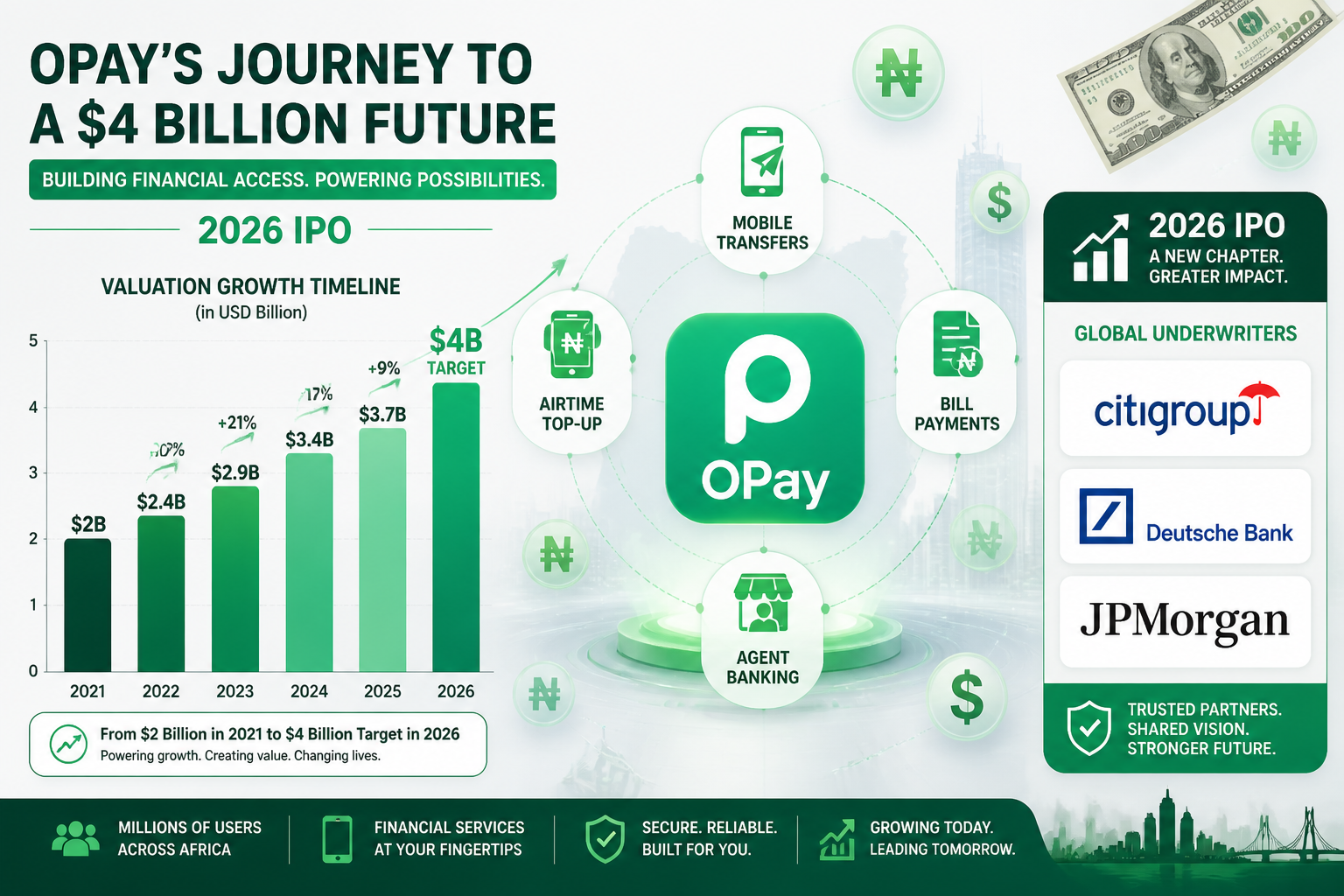
- OPay is targeting a US IPO at a $4 billion valuation in 2026, double its 2021 valuation of $2 billion.
- Citigroup, Deutsche Bank, and JPMorgan have been hired as lead underwriters.
- OPay reported $614.8 million in revenue for 2025, a 28% year-on-year increase.
- The IPO will force OPay to publicly disclose financial data for the first time.
- For everyday Nigerian users, the app is unlikely to change dramatically — but transparency and accountability will increase.
What we know so far
This article is written and edited by Tech Embed.
It is based on reports from reputable business publications, OPay’s official product information and publicly available investor material from Opera Limited.
OPay has not publicly filed an IPO prospectus with US regulators at the time of writing. Reports about the planned listing are based on people familiar with the matter, not a final public filing.
One important correction: some public summaries have linked a $614.8 million 2025 revenue figure to OPay. That figure comes from Opera Limited’s 2025 full-year results, where Opera reported its own full-year revenue. It should not be treated as OPay’s standalone revenue unless OPay or a filing confirms it.
What the OPay US IPO reports say
OPay Digital Services is reportedly preparing for a possible initial public offering in the United States.
BusinessDay reported that the SoftBank-backed fintech has hired Citigroup, Deutsche Bank and JPMorgan Chase to lead the planned listing. The report said OPay is targeting a valuation of about $4 billion, although timing and deal size remain fluid.
TheCable also reported that the company is working with the three banks for an IPO and may proceed with the share sale later in 2026. TheCable noted that OPay, the banks and Citi, Deutsche Bank and JPMorgan had not publicly commented on the plans.
That makes the OPay US IPO story a serious market signal, but not a completed listing.
Until OPay files publicly with the US Securities and Exchange Commission, the exact numbers, risks, revenue, profit, user base and listing structure remain unconfirmed.
Why the OPay US IPO valuation matters
A $4 billion valuation would put OPay among the most closely watched African fintech companies if the listing goes ahead. It also explains why the OPay US IPO discussion is attracting attention beyond Nigeria’s fintech sector.
The number matters for three reasons.
First, it shows how much global investors may be willing to pay for a large Nigeria-focused payments business.
Second, it would place OPay under public-market pressure. Public companies must report more information than private companies. They also face questions from shareholders, analysts and regulators.
Third, it could affect Nigeria’s wider fintech market. Competitors such as PalmPay, Moniepoint, Kuda, MTN MoMo and payment gateway companies will watch closely because a successful listing could shape investor confidence in African fintech.
But a target valuation is not the same as a final market value. IPO pricing can change before listing, especially if market conditions shift.
What OPay does in Nigeria
OPay is already deeply embedded in Nigerian payments.
On its official website, the company describes itself as a platform for secure, easy and affordable financial services. It says users can fund wallets, make transfers, pay bills, buy airtime and data, use debit cards, and access savings products.
That explains why the IPO story matters beyond investors.
A student may use OPay to receive money and buy data. A trader may use it to accept payments. A POS operator may depend on it for cash-in and cash-out services. A small business owner may use it as a daily payment tool.
When a platform like that moves toward public markets, the impact is not only financial. It can affect how the company invests in service quality, compliance, support and product expansion.
What the OPay US IPO could change for users
Nothing may change immediately.
The app will not suddenly become different because OPay is preparing for a listing. Users should not expect instant changes to transfers, bill payments, card use or agent services because of the OPay US IPO reports alone.
But over time, four things could matter.
More transparency
A US IPO would require OPay to disclose more financial and operational information than it currently publishes as a private company.
That could help users, analysts and regulators understand how the company makes money, how fast it is growing and what risks it faces.
More pressure to grow revenue
Public companies often face pressure to increase revenue and improve margins.
That does not mean OPay will raise fees. No such change has been announced. But users should watch transfer charges, card fees, bill payment costs, merchant pricing and promotional offers after any listing.
More investment in infrastructure
If OPay raises fresh capital, it may have more room to invest in transaction reliability, customer support, fraud prevention, agent tools and new products.
That would matter for Nigerian users because failed transfers, delayed reversals and unclear support processes are among the most stressful parts of digital payments.
More regulatory visibility
A public listing could make OPay’s compliance systems more visible.
For a fintech operating in Nigeria’s regulated financial sector, that is important. Investors will want to know how the company handles know-your-customer checks, fraud risk, consumer protection, data security and relationships with regulators.
The risks to watch before the OPay US IPO
The OPay US IPO story is promising, but it should not be treated as a victory lap.
OPay still operates in a difficult market. Nigeria’s payment system faces network issues, fraud risks, agent disputes, user-support complaints and changing regulation.
OPay’s own website says user data is encrypted, transactions are PCI DSS compliant and users can lock an account or card through USSD if a phone is stolen or misplaced. Those are useful trust signals, but they do not remove every risk.
The biggest questions are still open.
Will OPay publish stronger data on failed transactions and reversals? Will support improve for users outside major cities? Will agent fraud be handled more aggressively? Will pricing stay friendly for everyday users? Will public investors push the company toward growth decisions that users may not like?
These are the questions Nigerian users should keep asking.
Why this matters for Nigerian fintech
If OPay lists successfully in the US, it could become a signal for the wider Nigerian fintech ecosystem.
It would show that a Nigeria-focused financial technology company can move from mass-market payments to global public-market attention.
That could help other fintech companies raise capital. It could also raise the bar for reporting, governance and consumer trust.
Still, OPay is not the whole market. Nigerian payments include wallets, banks, POS agents, mobile money operators and payment gateways. For business owners comparing payment infrastructure, Tech Embed’s Paystack vs Flutterwave guide explains how payment gateways differ on fees, settlement, developer tools and cross-border reach.
That wider context matters because users do not only care about valuations. They care about whether payment systems work when money is on the line.
What to watch next for the OPay US IPO
The next major step for the OPay US IPO is an official filing.
Until OPay files with US regulators, key details remain uncertain. A filing would show revenue, profit or loss, user numbers, risks, ownership structure, legal issues, market strategy and how much the company wants to raise.
Users should also watch for changes inside the app.
Fee updates, product changes, support improvements, new card features, merchant tools and agent policies will tell users more than IPO headlines alone.
A $4 billion valuation may impress investors. But for Nigerians using OPay every day, the better test is simpler: does money move quickly, safely and with less stress?
Source and author note
This article was prepared by Tech Embed using reputable business reports, OPay’s official website and Opera Limited’s public investor materials.
Tech Embed has not independently verified OPay’s private financials and has not seen a public IPO prospectus. Where details are still based on reports or people familiar with the matter, the article states that clearly instead of treating them as final.
FAQ
Is OPay going public in the US?
Reports say OPay is preparing for a possible US IPO and has hired major banks to work on the process. But the company has not yet filed a public IPO prospectus.
What valuation is OPay targeting?
Reports say OPay is targeting a valuation of about $4 billion. That number can still change before any listing.
Will the OPay US IPO affect Nigerian users?
Not immediately. The app should continue to work as usual. Over time, users should watch for fee changes, better support, new products and service improvements.
Is OPay’s 2025 revenue public?
OPay has not publicly released full standalone IPO financials. The $614.8 million figure seen in some discussions refers to Opera Limited’s 2025 full-year revenue, not confirmed OPay standalone revenue.
Is OPay safe to use in Nigeria?
OPay says it uses encrypted data storage, PCI DSS-compliant transactions and account/card locking features. Users should still protect their PIN, avoid sharing one-time passwords and report suspicious activity quickly.
About Tech Embed
Tech Embed is a digital media platform covering technology, fintech, startups and digital trends across Nigeria and Africa. We focus on breaking down complex systems into clear, practical insights that explain how technology affects everyday life and business.
We publish analysis-driven content on digital systems shaping the African tech ecosystem.
Source notes can be added in the editorial fields for this story.
No comments