



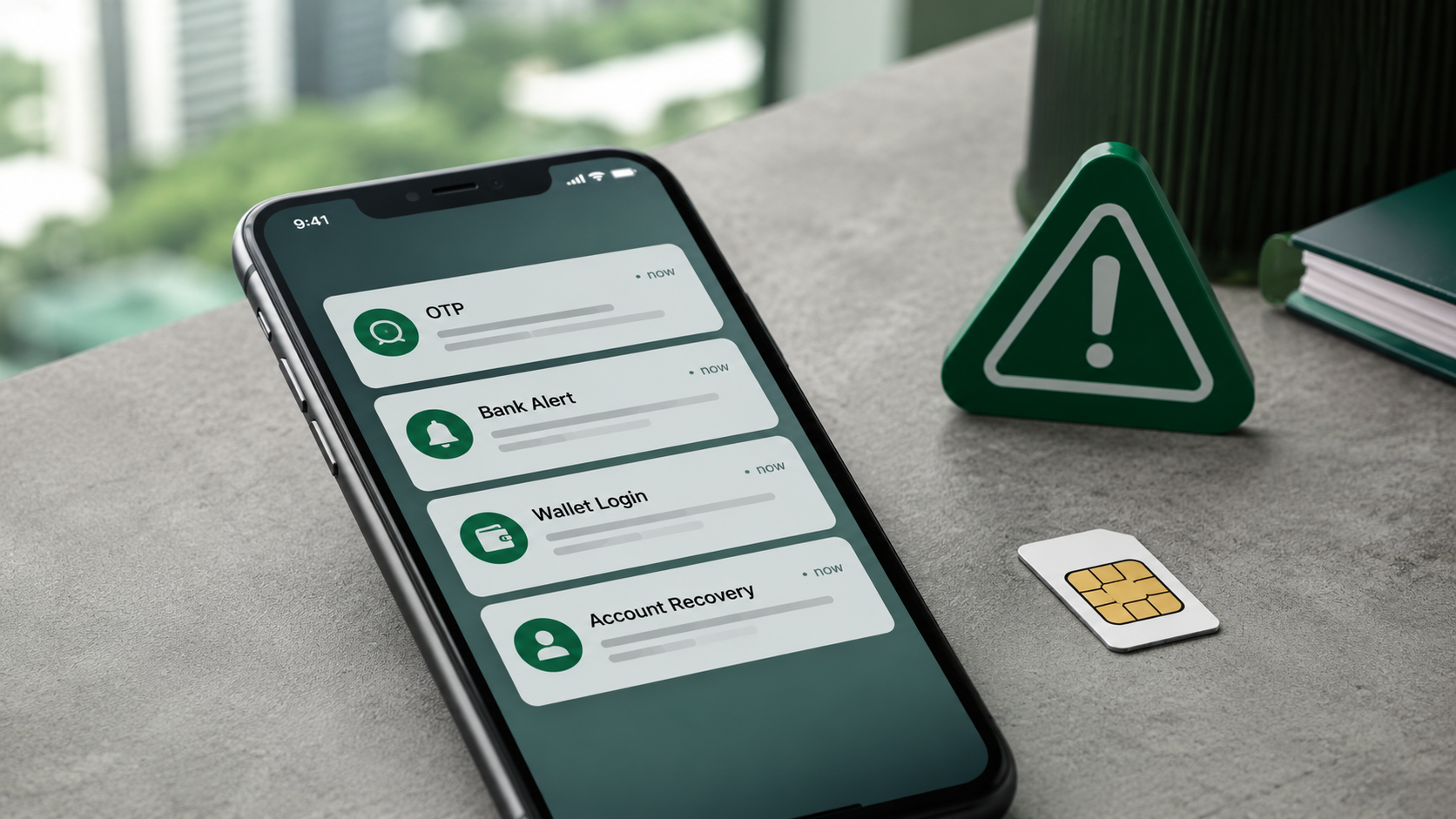
A phone number can look harmless.
Eleven digits. A SIM card. A network bar on your screen.
But in Nigeria today, that number may be connected to your bank account, mobile wallet, WhatsApp, email, loan app, delivery profile, business page and one-time password alerts.
Now imagine you stop using that number.
Maybe the SIM got lost. Maybe you travelled. Maybe you moved to another network. Maybe the line became inactive and you forgot about it.
Months later, the number may return to the market and land in another person’s phone.
Your SIM is gone.
Your number has moved on.
But some of your digital accounts may still remember it.
That is why recycled SIM cards in Nigeria are becoming a fraud risk.
This is no longer just a telecom issue. It is a digital identity issue. Nigeria’s phone numbers have become part of how people bank, receive money, recover accounts and prove who they are online. But phone numbers are not permanent identity documents. They can be lost, swapped, abandoned, deactivated and reassigned.
That gap is what the Nigerian Communications Commission is trying to close with the Telecoms Identity Risk Management System, also known as TIRMS.
Short answer: Recycled SIM cards in Nigeria are becoming a fraud risk because phone numbers are now used for banking, fintech access, OTPs, account recovery and digital identity checks. When recycled phone numbers are reassigned without enough risk checks, old accounts may still treat the number as trusted. NCC’s TIRMS platform is designed to help approved organisations verify whether a number has been churned, swapped, reassigned, blacklisted or otherwise risky before sensitive actions happen. (doc.tirms.ncc.gov.ng)
Why recycled SIM cards in Nigeria are becoming risky
A recycled SIM card is a phone number that once belonged to one subscriber, became inactive, and was later assigned to another subscriber.
The physical SIM card may be new. The risk sits with the phone number.
In telecom language, a number that becomes inactive can be treated as a churned number. NCC’s TIRMS documentation defines churned numbers as recycled numbers and lists related phone-number statuses such as swapped, blacklisted, reassigned and normal. (doc.tirms.ncc.gov.ng)
This is not automatically bad.
Phone numbers are limited. Telcos cannot keep every unused number forever. If millions of people abandon old lines, operators eventually need to return some numbers to circulation.
The problem starts when the old number is still connected to digital services.
A new user may buy a SIM and begin receiving messages meant for the former owner. It may be harmless, like an old promo SMS. It may also be sensitive, like a bank alert, wallet notification, loan reminder, delivery message or login code.
That is the issue behind SIM recycling fraud Nigeria searches: an old number returns to circulation while banks, wallets or apps may still treat it as trusted.
The fraud risk does not come from recycling alone. It comes from the way banks, fintechs, apps and users continue to trust phone numbers after those numbers have changed hands.
Why phone numbers now carry more risk than before
Years ago, a phone number was mostly for calls and text messages.
That world is gone.
Today, one Nigerian phone number can be linked to bank alerts, mobile banking apps, fintech wallets, WhatsApp, email recovery, loan apps, delivery apps, ride-hailing apps, social media accounts, betting accounts, business pages and Know Your Customer records.
This makes the phone number a digital key.
Not the only key, but a very important one.
When you forget a password, a platform may send a code to your phone.
When your bank wants to confirm a login, it may send an OTP.
When WhatsApp wants to restore access, it may rely on your number.
When a fintech app wants to verify a user, the phone number may be part of the check.
That is why recycled phone numbers Nigeria-wide are now a security issue. A number can leave one person’s control but still remain inside old account records.
NCC’s TIRMS documentation shows how seriously the regulator now treats phone-number status. The system gives approved organisations a way to verify whether a number is churned, swapped, blacklisted, reassigned or normal. (doc.tirms.ncc.gov.ng)
The deeper issue is simple: Nigeria’s digital economy depends heavily on phone numbers, but phone numbers can change hands.
How recycled SIM cards can create fraud risk
A recycled number does not automatically give the new user access to the former owner’s bank account.
But it can create openings.
The first risk is account recovery.
If an old number is still attached to an email, wallet or social account, a recovery code may go to the wrong person.
The second risk is OTP exposure.
Some platforms still rely heavily on SMS one-time passwords. If a number has changed hands and the old account has not been updated, the wrong person may receive sensitive codes.
The third risk is identity confusion.
A new user may inherit calls, messages or suspicion linked to the previous owner of the number. Reports on NCC’s TIRMS plan have described this as one reason the regulator wants a clearer system for tracking churned and recycled mobile numbers across sectors. (TheCable)
The fourth risk is social engineering.
A fraudster may combine a recycled number with leaked personal information, old messages or weak customer support checks to impersonate someone.
This is where mobile number fraud Nigeria-wide becomes a cross-sector problem. A telecom number can become a banking problem. A banking problem can become a fintech problem. A fintech problem can become a consumer protection problem.
SIM recycling is not the same as SIM swap fraud in Nigeria
SIM recycling and SIM swap fraud are related, but they are not the same.
A recycled SIM involves a number that became inactive or churned before being reassigned.
SIM swap fraud Nigeria cases involve a different risk: a criminal tries to move an active victim’s number to another SIM. The goal is often to intercept calls, messages or authentication codes.
The difference matters.
In SIM swap fraud, the attacker is trying to take over a live number.
In SIM recycling fraud, the number may have been abandoned before being reassigned.
But both problems point to the same weakness: too many services still trust phone numbers too much.
A phone number can help confirm identity, but it should not be treated as permanent proof that the person holding the number is the original account owner.

What NCC is changing about SIM fraud
NCC is responding through the Telecoms Identity Risk Management System.
TIRMS is a secure platform for checking and updating the status of mobile phone numbers across participating platforms. NCC’s official API documentation says telecom operators can update phone-number status, while approved service providers such as fintechs, banks and insurance companies can verify number status for onboarding, authentication or transactions. (doc.tirms.ncc.gov.ng)
This is the centre of the NCC SIM fraud response.
The goal is not only to know that a number exists. The goal is to know what has happened to that number.
Was it churned?
Was it swapped?
Was it reassigned?
Was it blacklisted?
Is it normal?
Should a service provider apply extra checks?
The TIRMS documentation also shows that approved organisations need registration, approval and API keys before using the system. This means the platform is not designed as a public lookup tool for ordinary users. It is an institutional risk-checking layer. (doc.tirms.ncc.gov.ng)
TIRMS Nigeria is not a consumer app. It is digital trust infrastructure.

What the proposed 14-day SIM notice means
TIRMS is visible through NCC’s official documentation, but some supporting regulatory changes are still tied to the consultation and amendment process.
One major proposed change is a 14-day notice before a line is churned.
PUNCH reported that NCC proposed a rule requiring telecom operators to give subscribers at least 14 days’ notice before deactivating SIM cards over inactivity or post-paid churn. The report also said the proposal would require operators to submit churned-number details to TIRMS within seven days after the churn process is completed. (Punch Newspapers)
This matters because many users do not realise the risk until it is too late.
A 14-day notice could give a user time to reactivate, park or update the line before losing control of the number.
For dormant SIM cards Nigeria users have forgotten about, this could become a practical safety window. If a user receives a warning that an old line is about to be churned, they can update bank records, wallet profiles, WhatsApp recovery, email recovery and business accounts before the number returns to circulation.
The key word is “could.”
The rule will only work well if telcos notify users clearly, use reliable alternative contact channels, and make the process easy to understand.
Why banks and fintechs should care
Banks and fintechs should care because phone numbers sit inside their security systems.
A customer’s mobile number may be used for alerts, onboarding, OTPs, login verification, transaction confirmation, password reset and fraud monitoring.
If the number changes status and the financial institution does not know, there is a blind spot.
That is why the Central Bank of Nigeria and NCC signed a memorandum of understanding in April 2026 to tackle SIM-related fraud and strengthen consumer protection across Nigeria’s digital ecosystem. PUNCH reported that the agreement focuses on electronic fraud linked to mobile numbers, payment-system integrity and better coordination between the financial and telecom sectors. (Punch Newspapers)
The agreement also identifies the Telecom Identity Risk Management Portal as a data-sharing platform designed to detect fraud linked to recycled, swapped or blacklisted phone numbers. It is expected to enable real-time mobile-number-status verification across banks and fintech firms. (Punch Newspapers)
That is a major shift.
It means regulators are beginning to treat phone-number history as part of financial-risk management.
A bank should know if a number attached to a customer profile was recently swapped.
A fintech should know if a number was recently recycled.
A wallet provider should know if a number was blacklisted or reassigned.
A telco should be able to report status changes that affect identity risk.
This is how digital trust becomes shared infrastructure.
The fraud problem is still large
Nigeria has made progress on digital-payment fraud, but the problem is far from solved.
The Nigeria Inter-Bank Settlement System reported that digital-payment fraud losses fell to ₦25.85 billion in 2025, down from ₦52.26 billion in 2024. That is a 51 percent decline, but it is still a large amount of money lost through electronic fraud channels. (NIBSS)
NIBSS also reported that fraud incidents fell from 123,918 in 2021 to 67,518 in 2025, while e-commerce and internet banking remained among the most affected channels. The same report noted that SIM swap fraud, account compromise and phishing continue to evolve. (NIBSS)
This is why NCC’s move matters.
Fraud is not only about stolen passwords. It is also about identity signals. A phone number is one of those signals.
If a system cannot tell whether a number is stable, newly reassigned, recently swapped or linked to fraud, it may trust the wrong signal.
The real issue is blind trust in phone numbers
It is easy to blame recycled SIM cards.
But recycled SIM cards are only one part of the story.
The deeper issue is that many digital services still treat phone numbers as if they are permanent identity documents.
They are not.
People lose phones.
SIMs get damaged.
Users abandon lines.
Families share phones.
Small businesses change numbers.
Workers leave company lines behind.
Users migrate from one network to another.
Fraudsters exploit weak checks.
A phone number can help identify a person, but it should not be the whole identity system.
Banks and fintechs need stronger device checks, better risk scoring, clearer account recovery steps and safer customer-update processes.
Telcos need cleaner records, timely status updates, better SIM swap controls and clearer warnings before churn.
Regulators need shared standards, privacy safeguards and enforcement.
Users need better awareness.
This is the real lesson: recycled SIM cards are not the enemy. Weak account recovery systems, poor user updates and blind trust in phone numbers are the bigger problem.

What to do before you abandon a SIM card in Nigeria
Before you stop using a number, treat it like a digital key.
Do not just remove the SIM from your phone and forget it.
First, update your bank profile.
Make sure your current phone number is linked to your bank account, mobile app and relevant customer records.
Next, update your fintech wallets.
Check savings apps, payment apps, investment apps, crypto apps, loan apps and any wallet that sends alerts or verification codes to your number.
Then check WhatsApp and email recovery.
If your old number is still your recovery option, change it before you lose access.
Also check social media accounts.
Facebook, Instagram, X, TikTok, LinkedIn and business pages may still use your number for password reset or account recovery.
Do not forget delivery and ride-hailing apps.
They may expose addresses, order history or personal details if someone else gains access.
If the number is important, do not let it go dormant.
Keep proof of ownership. Keep it active. Or use any official line-preservation option your operator provides.
For business owners, the warning is even stronger.
A business line may be tied to customers, WhatsApp Business, payment links, supplier contacts, bank alerts and social media pages. Losing that number can create confusion, impersonation risk and lost customer trust.
Quick guide: SIM fraud terms explained
| Term | Simple meaning | Why it matters |
|---|---|---|
| Recycled SIM | An inactive number is reassigned to a new user | Old account links may remain |
| Churned number | A number removed after inactivity | It may later return to circulation |
| Dormant SIM | A SIM or line that has been inactive | It may eventually be churned |
| SIM swap | A number is moved to another SIM | Criminals may use it to intercept OTPs |
| Reassigned number | A number allocated to a new user | Old records may still point to it |
| Blacklisted number | A number flagged or blocked because of risk | It may trigger extra checks |
| TIRMS | NCC’s telecom identity risk platform | It helps approved institutions check number status |
The privacy questions NCC still needs to answer
TIRMS may help reduce fraud, but it also raises privacy questions.
Who can access the data?
What exact information will be shared?
How long will records be stored?
Can a user challenge a wrong flag?
Will innocent users be blocked because their number once had a bad history?
How will consent, encryption and access control work?
What happens if participating institutions misuse the data?
These questions matter because phone-number data is personal data.
Nigeria already has a data protection regulator. The Nigeria Data Protection Commission is responsible for safeguarding data privacy and enforcing responsible data handling under the Nigeria Data Protection Act 2023. (ndpc.gov.ng)
That means TIRMS should not only be judged by whether it helps catch fraud.
It should also be judged by whether it protects ordinary users from unfair blocking, poor records and unnecessary exposure of personal information.
A fraud system that creates new privacy risks will not build trust.
What good implementation should look like
For TIRMS to work well, it needs more than a portal.
It needs clear rules.
Telcos should update number status quickly and accurately.
Banks and fintechs should use the data as a risk signal, not as the only reason to block a customer.
Regulators should publish clear safeguards.
Users should receive simple warnings before numbers are churned.
There should be a process for correcting wrong records.
Public education should explain why old numbers should not be abandoned carelessly.
The danger is that TIRMS becomes invisible infrastructure that affects users without users understanding how it works.
The better outcome is different.
A customer tries to reset a wallet with a number that has just been reassigned. The fintech sees the risk and asks for stronger verification. A bank notices that a number was recently swapped and delays a sensitive change. A telco reports a churned number quickly so another institution does not keep trusting it blindly.
That is how the system should work.
Not by punishing users, but by slowing down risky actions before fraud happens.
FAQs about recycled SIM cards in Nigeria
What are recycled SIM cards in Nigeria?
Recycled SIM cards in Nigeria are phone numbers that were once used by another subscriber, became inactive, and were later reassigned to a new user.
The risk is not the new SIM card itself. The risk is that old bank, wallet, social media or recovery accounts may still trust the number.
Why is SIM recycling fraud Nigeria becoming a concern?
SIM recycling fraud Nigeria is becoming a concern because phone numbers are now tied to bank alerts, OTPs, wallets, social accounts and recovery systems.
If a number changes hands but old accounts still trust it, users and financial institutions may face new fraud risks.
Can someone access my bank account with my old number?
Not automatically.
But if your old number is still linked to OTPs, alerts or account recovery, it can create security risks. That is why you should update your bank and fintech records before abandoning a number.
What is TIRMS Nigeria?
TIRMS Nigeria refers to NCC’s Telecoms Identity Risk Management System. It allows approved organisations to verify mobile-number status and check whether a number has been churned, swapped, reassigned, blacklisted or marked normal. (doc.tirms.ncc.gov.ng)
What is NCC changing about SIM fraud?
NCC is using TIRMS to improve mobile-number risk checks across sectors. It has also proposed rule changes that would require telcos to notify subscribers before churning lines and submit churned-number details to TIRMS after the churn process. (Punch Newspapers)
Is SIM recycling the same as SIM swap fraud?
No.
SIM recycling happens when an inactive number is reassigned. SIM swap fraud happens when criminals try to move an active victim’s number to another SIM. Both can create risk because many services still depend on phone numbers for verification.
What should I do before abandoning a SIM card in Nigeria?
Update your bank, fintech wallet, WhatsApp, email, social media and business-account recovery details.
Also check loan apps, delivery apps, ride-hailing apps and any service that still sends codes or alerts to that number.
Are recycled SIM cards always dangerous?
No.
Most recycled numbers may never cause a problem. The risk appears when old accounts still trust the number after it has changed hands.
What this means for Nigeria’s digital trust
Recycled SIM cards in Nigeria are becoming a fraud risk because phone numbers have become too important to be treated casually.
They are now part of how people bank, receive money, verify accounts, recover passwords and prove identity.
NCC’s TIRMS system is a sign that regulators understand the problem is cross-sector. Telcos cannot solve it alone. Banks cannot solve it alone. Fintechs cannot solve it alone.
But the real test will be implementation.
Will telcos notify users properly before numbers are churned?
Will banks and fintechs integrate the platform responsibly?
Will users be educated clearly?
Will privacy safeguards be strong enough?
Will flagged numbers be handled fairly?
Will there be a simple way to correct wrong records?
The phone number has become one of Nigeria’s most important digital identity tools.
Now the rules around it have to catch up.
About Tech Embed
Tech Embed is a digital media platform covering technology, fintech, startups and digital trends across Nigeria and Africa. We focus on breaking down complex systems into clear, practical insights that explain how technology affects everyday life and business.
We publish analysis-driven content on digital systems shaping the African tech ecosystem.
Source notes can be added in the editorial fields for this story.
No comments