Your transfer is pending.
It has been 48 hours. Rent is due tomorrow. The person you sent money to says nothing has entered. Customer support has replied with a ticket number, but there is still no clear answer.
That moment is where the real OPay vs PalmPay comparison begins.
Most reviews focus on app colour, free transfers, savings rate, rewards and user numbers. Those things matter. But for everyday payments in Nigeria, the real question is simpler: which app works better when money needs to move fast, safely and without unnecessary stress?
OPay and PalmPay are two of the biggest mobile wallet apps in Nigeria. Both let users send money, receive transfers, buy airtime and data, pay bills, save money and use card or agent-related services. Both have grown beyond simple fintech apps. For many Nigerians, they are now part of daily financial life.
Short answer: OPay is stronger for offline access, debit cards, POS visibility, merchant tools and agent network reach. PalmPay is stronger for free transfers, rewards, savings rates and published transaction reliability. The better choice depends on how you use money every week.

For wider Nigerian fintech context, you can also read Tech Embed’s report on what OPay’s reported US IPO could mean for Nigerian users and its coverage of MTN Nigeria MoMo PSB’s 2026 stake sale.
What We Verified
This article is written and edited by Tech Embed. It draws on official OPay product information, official PalmPay Nigeria information, app listings, security documentation, company disclosures and publicly reported industry data reviewed at the time of writing.
We compared the apps based on the payment questions that matter most to everyday users in Nigeria:
- Can you send money easily?
- Can you buy airtime and data without stress?
- Can you pay bills and get a clear receipt?
- Can you access cash through agents?
- Can you get a debit card?
- Can you earn interest on idle balance?
- Can you get rewards?
- How visible is customer support?
- What happens when a transaction fails?
One limitation should be clear. Tech Embed did not independently force a failed transaction or run a controlled reversal test for this article. That means we cannot honestly claim that one app reverses failed payments faster than the other based on our own fieldwork. Where failed transaction recovery is discussed, we rely on official support information, public reports and user-reported patterns.
That limitation matters because transaction success is only part of reliability. The deeper test begins when money leaves your wallet but does not reach the receiver, when a bill payment hangs as “processing,” or when you need support to reverse a failed card or bank transfer.
Fees, rates, limits and features can change. Confirm the latest details inside the official app before making large or time-sensitive payments.
Tech Embed Live Payment Check: What We Could Confirm
For everyday Nigerian users, the most useful payment checks are simple: bank transfers, airtime or data top-ups, bill payments, fee display, transaction receipts and support visibility.
A normal successful transfer shows that the app can work. A failed transfer shows how the company behaves when the user is under pressure.
| Test Area | Why It Matters | What Readers Should Check |
|---|---|---|
| Bank transfer | This is the main reason many Nigerians use OPay and PalmPay. | Recipient name, fee display, speed and final status. |
| Airtime/data purchase | Students, workers and business owners use this often. | Discount, cashback, speed and recharge delivery. |
| Bill payment | Electricity, TV and internet bills can be time-sensitive. | Provider name, token delivery and receipt record. |
| Failed transaction | This is the biggest missing fieldwork test. | Support response, dispute process and reversal timeline. |
| Customer support | Support matters most when money is stuck. | In-app chat, phone, email, social media and physical office options. |
The biggest missing data point is still one documented failed transaction or reversal experience. That fieldwork would make the comparison stronger because it would show how each app handles pressure, not just how each app performs when everything goes right.
For readers, the practical lesson is this: don’t judge a payment app only by free transfers. Judge it by what happens when a transfer fails.
OPay vs PalmPay at a Glance
Best for Everyday Visibility: OPay
OPay has stronger offline visibility across Nigeria, especially through POS agents, merchant points, debit card access and street-level usage.
Best for Free Transfers and Rewards: PalmPay
PalmPay is stronger for users who care about free transfers, cashback, coupons, savings rewards and repeat app-based payments.
Best for Small Businesses: OPay
OPay has an edge because of OPay Checkout, merchant payment acceptance and wider agent visibility.
Best for Students and Frequent Transfers: PalmPay
PalmPay’s free-transfer positioning, cashback rewards and higher advertised savings rate make it attractive for students and frequent app users.
Best for Offline Cash Access: OPay
OPay’s agent network and debit card availability make it easier for users who need cash withdrawals, POS access and physical support.
Best Published Reliability Claim: PalmPay
PalmPay’s published transaction success rate is one of its strongest public claims and directly addresses everyday payment anxiety. Treat it as company-reported unless an independent audit is provided.
OPay vs PalmPay Comparison Table
| Factor | OPay | PalmPay |
|---|---|---|
| Registered users | 50 million plus reported users. | 35 million plus reported users. |
| Daily activity | Around 10 million daily active users reported. | Up to 15 million daily transactions reported. |
| Transaction success rate | Not clearly disclosed in the same public format. | Company-reported success rate publicly promoted by PalmPay and industry reports. |
| Agent/merchant network | Strong POS and agent visibility. | Large agent and merchant network, but less visible than OPay in some areas. |
| Transfer fees | Free bank transfers claimed for consumer users. | Unlimited free transfers claimed. |
| Savings rate | OWealth offers interest on wallet balance. | SmartEarn/Cashbox offers higher advertised returns. |
| Rewards | Available, but less central to the app experience. | Cashback, coupons and promotions are stronger. |
| Debit card access | OPay’s Play Store listing describes card application through the app with delivery or agent-store options. | Card available through app process, with fewer visible offline pickup points. |
| Security | CBN-listed payment service provider and NDIC-listed mobile money operator. | CBN-listed payment service provider and NDIC-listed mobile money operator. |
| Business tools | OPay Checkout gives it a merchant advantage. | Better as a consumer wallet than full merchant checkout tool. |
| Customer support | In-app support, hotlines and physical centres. | In-app support, helpline, email and office contact. |
| Failed transaction handling | Dispute process exists, but reversal timing still needs field testing. | Dispute process exists, but reversal timing still needs field testing. |
If you follow Nigeria’s wider digital payment space, Tech Embed’s Tech News section covers fintech, mobile money, AI, telecoms and digital economy stories for Nigerian readers.
What OPay Does Well

OPay launched in Nigeria in 2018 and has grown into one of the country’s most visible fintech platforms. The company describes itself on its official website as a platform for secure, easy and affordable financial services, covering transfers, bills, debit cards and everyday payments.
The strength of OPay is not only inside the app. It is also on the street.
In many Nigerian markets, motor parks, residential areas and business centres, OPay agents are easy to spot. Green POS stands, umbrellas and kiosks have become part of everyday payment culture. For people who need to withdraw cash, deposit money, receive payments or speak with an agent nearby, that physical presence matters.
This makes OPay useful for traders, small business owners, transport workers, salary earners and people who still move between cash and digital money every day.
OPay also has a debit card advantage. Its Google Play listing describes card application through the app, with delivery options or selected agent-store access. For someone who needs card access without going through a traditional bank process, that is useful.
For savings, OPay offers OWealth, which allows users to earn interest on wallet balance while still having access to their money. For users who leave money inside a wallet between paydays or project payments, this can add some value.
OPay also has a stronger business angle. OPay Checkout gives merchants a more structured way to accept payments online. That makes it more useful for small businesses that want payment collection beyond simple wallet transfers.
OPay’s Core Strengths
- Strong offline visibility across Nigerian cities and markets.
- Large user and merchant base.
- Debit card access through app and selected channels.
- OWealth savings product.
- OPay Checkout for business payment collection.
- USSD account and card locking for stolen or missing phones.
- Physical customer service centres in addition to in-app support.
Where OPay Falls Short
OPay’s main weakness appears when transactions become complicated. Simple peer-to-peer transfers are generally where users praise the app. The complaints become louder around failed transactions, card-related refunds, delayed reversals and support escalation.
Some user reports mention pending transactions, slow dispute resolution or card reversals that require several working days. This does not mean every user will face the same issue. It means the article should treat failed payment recovery as a serious part of the comparison.
For daily transfers and broad payment access, OPay is strong. For disputed card payments or complex refund cases, users should keep records and avoid relying on only one payment option for urgent transactions.
For more background on OPay’s growth and public-market scrutiny, read Tech Embed’s article on OPay’s reported US IPO plans.
What PalmPay Does Well
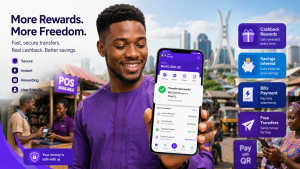
PalmPay launched in Nigeria in 2019 and has grown quickly. In a 2025 industry update, PalmPay was reported to have more than 35 million Nigerian users and up to 15 million transactions daily. A 2026 profile also described PalmPay as serving over 35 million users in Nigeria.
PalmPay’s biggest advantage is its consumer-focused app experience.
The app is built around free transfers, rewards, coupons, cashback and savings. For users who pay bills, buy data, transfer money often and like seeing rewards from routine spending, PalmPay feels more rewarding than OPay.
The headline figure that stands out is PalmPay’s transaction success rate, which has been publicly promoted by the company and reported by industry publications. This is not the same as an independent audit, so readers should treat it carefully. Still, it directly answers the concern most Nigerian users have with mobile wallets: will my transfer go through?
PalmPay also has a stronger savings-rate story. Its SmartEarn or Cashbox-style wealth products advertise higher returns than OPay’s stated OWealth ceiling. Public reports have also mentioned significant interest payouts to users of PalmPay’s wealth products, which suggests the savings feature is not just a decorative button inside the app.
PalmPay’s rewards layer is also more aggressive. Cashback, coupons, free-transfer bonuses and bill-payment rewards are part of the app’s positioning. For students, young workers and frequent app users, those small benefits can add up over time.
PalmPay’s Core Strengths
- Strong published transaction success positioning.
- Free-transfer positioning.
- Cashback, coupons and rewards.
- Higher advertised savings rate.
- Strong consumer app experience.
- Large user base and daily transaction volume.
- Security and data-protection positioning publicly highlighted.
Where PalmPay Falls Short
PalmPay’s offline visibility is not as strong as OPay’s in many everyday Nigerian environments. Although PalmPay has a large agent and merchant network, users in some smaller cities or less central areas may find OPay agents easier to locate.
PalmPay is also not as strong as OPay for merchant checkout infrastructure. It works well for simple wallet use, transfers and consumer payments, but OPay has the clearer advantage for small business owners who need more structured online payment collection.
PalmPay is better for rewards and app-based payments. OPay is better when physical access, agent presence and merchant tools matter more.
OPay vs PalmPay Fees and Charges
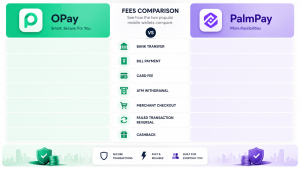
Both OPay and PalmPay promote free or low-cost payments. That sounds simple, but the real cost of a payment app in Nigeria is bigger than the transfer fee shown on the screen.
For Nigerian users, cost includes:
- Transfer charges.
- Regulatory deductions.
- Failed transaction delays.
- ATM or card charges.
- Time spent chasing support.
- Business payment costs.
- Emotional stress when money is stuck.
A free transfer that fails and takes days to reverse is not really free. It costs time. It can cost business trust. It can also create pressure if rent, school fees, stock purchase or emergency payment is involved.
OPay says users can transfer to bank accounts for free on consumer transfers. PalmPay promotes unlimited free transfers to all banks. PalmPay strengthens that claim with its published reliability positioning, but users should still check the app before sending money.
Regulatory deductions such as stamp duty may apply depending on the type or value of the transaction. ATM withdrawals may also attract normal card or interbank charges. For businesses, OPay Checkout has a separate pricing structure from normal consumer wallet transfers.
Real-Life Fee Situations to Check
| Payment Situation | Why It Matters | OPay | PalmPay |
|---|---|---|---|
| ₦1,000 airtime or data top-up | Common student and worker use. | Check discount, delivery speed and receipt. | Check discount, cashback and rewards. |
| ₦10,000 bank transfer | Common daily transfer amount. | Check fee before confirmation. | Check fee before confirmation. |
| ₦50,000 bank transfer | Higher-risk everyday transfer. | Confirm name and keep receipt. | Confirm name and keep receipt. |
| Electricity bill payment | Token delay can create stress. | Check token delivery and receipt. | Check token delivery and receipt. |
| ATM withdrawal with card | Useful when wallet balance needs cash. | Standard ATM/card charges may apply. | Standard ATM/card charges may apply. |
| Failed transfer reversal | Most important reliability test. | Dispute process exists, timing should be documented. | Dispute process exists, timing should be documented. |
| Merchant payment | Important for business owners. | OPay Checkout gives it an edge. | Better for consumer wallet use. |
The stronger app is not simply the one that charges less. It is the one that shows the fee clearly, completes the payment quickly, gives a usable receipt and resolves problems without making the user beg for updates.
For small daily transactions, PalmPay’s rewards and free-transfer positioning give it an advantage. For business use, OPay has the stronger fee story because of OPay Checkout and merchant payment acceptance.
For urgent payments above ₦50,000, the safer approach is simple: check the fee inside the app, confirm the recipient name, keep the transaction reference and have a backup bank app ready.
Transfers, Bills and Everyday Payments
Both OPay and PalmPay cover the basic payment tasks Nigerians perform every day. Users can send money, buy airtime, purchase data, pay bills and manage wallet balances.
The difference is how each app feels in daily use.
OPay feels more direct. It is built for quick transfers, card access, agent use and broad payment coverage. For someone who wants to open the app, send money and move on, OPay’s simplicity is a benefit.
PalmPay feels more reward-driven. The app experience leans more into bonuses, coupons, savings prompts and user engagement. For someone who likes cashback or uses one app for repeated small payments, PalmPay feels more attractive.
Students may prefer PalmPay because of free transfers, data rewards and savings returns. Traders may prefer OPay because of agent access and POS visibility. Freelancers may use either, depending on whether they care more about quick access or higher savings yield. Salary earners may prefer OPay as a broad single-app tool, while PalmPay can be useful for recurring bills and rewards.
Security, Fraud Protection and Account Safety

Both apps operate in a regulated Nigerian financial environment. OPay and PalmPay appear on the Central Bank of Nigeria’s payment service providers page. OPay and PalmPay also appear on the NDIC list of mobile money operators.
OPay highlights secure transactions, PCI DSS compliance, encryption, advanced fraud protection and instant account locking through USSD. Its USSD account and card locking feature is useful if a phone is stolen or misplaced, because the user may be able to lock access from another phone.
PalmPay publicly describes its service as licensed and regulated by the CBN, with deposits insured by the NDIC. PalmPay also highlights security and data protection positioning on its official pages.
Still, certifications do not protect users from every real-world risk.
The biggest risks for Nigerian mobile wallet users are often simple:
- Sharing OTPs.
- Using weak PINs.
- Giving strangers access to phones.
- SIM swap fraud.
- Fake customer care calls.
- Phishing links.
- Social engineering.
- Delayed reporting after phone theft.
SMS OTP remains a weak point across many financial apps because SIM swap fraud can expose users. If a fraudster successfully ports a number, they may receive OTPs and attempt to reset access. This is why users should protect their SIM, phone lock, app PIN and email account together.
The CBN also has a public fraud and scam awareness guide, which is useful for anyone using mobile wallets, bank apps or online payment tools.
Practical Safety Tips for Both Apps
- Enable biometric lock where available.
- Use a strong PIN that is different from your phone PIN.
- Never share OTPs with anyone.
- Lock your account quickly if your phone is missing.
- Confirm the recipient name before sending money.
- Avoid clicking strange payment links.
- Keep transaction references after every important payment.
- Report suspicious transactions immediately.
- Do not store large emergency funds in only one wallet.
What Happens When a Transaction Goes Wrong?
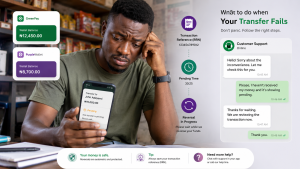
This is where the comparison becomes more serious.
Most payment apps look good when transfers succeed. The real difference appears when a transaction is pending, reversed late, sent to the wrong account, or tied to fraud. In those moments, users don’t care about colour, rewards or app design. They care about response speed, clear communication and whether their money returns.
A reported FIJ case published in January 2026 described a Nigerian publisher who said OPay and PalmPay had not resolved a ₦480,000 flagged transfer dispute for 11 months after money was allegedly taken by fraudsters. That case should not be treated as proof that every user will face the same experience. But it does show why dispute handling deserves a serious place in any OPay vs PalmPay comparison.
OPay lists in-app support, physical customer service centres, social media channels and hotline numbers. That physical presence matters for users who prefer face-to-face help or need escalation beyond chat.
PalmPay lists support channels including helpline, email, website support and office contact. Its published transaction success positioning suggests fewer transactions may reach dispute stage in the first place, but users still need clear reversal timelines when things go wrong.
Advertised support is not the same as resolved support.
Before depending on either app for large payments, test support with a simple low-risk question. Ask something specific inside the app and observe the response. A payment app that responds clearly before there is a crisis is easier to trust when money is stuck.
If a complaint is not resolved through the app, users can review the CBN’s complaints management guidance for regulated financial institutions.
What Real Users Are Saying
Official product pages tell one side of the story. Real user discussions show another side. For payment apps like OPay and PalmPay, that user experience matters because people judge these apps based on speed, transfer success, ads, rewards, support response and what happens when money gets stuck.
On Nairaland, a discussion titled Opay Vs Palmpay Which Do You Prefer shows users comparing both apps based on speed, usability and PalmPay’s in-app ads. Some users said both apps feel similar for basic transactions, while others preferred OPay because it feels cleaner and less distracting.
Another Nairaland thread, Opay And Palmpay Which One Is Better, includes users who strongly prefer OPay for daily transactions. These are personal opinions, not formal research, but they help show how Nigerian users talk about both apps in real life.
A more recent Nairaland discussion, Which Is More Reliable In 2026: Opay, PalmPay Or Moniepoint?, is useful because it reflects newer user conversations around reliability, savings and everyday fintech use.
On Reddit’s Nigeria community, the discussion Do people still use traditional Nigerian banks? shows how some Nigerians now see fintech apps like OPay and PalmPay as convenient alternatives for day-to-day transactions. Another Reddit thread, OPay/PalmPay vs Ghanaian Mobile Money Wallet, discusses small transfers and everyday wallet habits.
These community comments should not be treated as final proof that one app is better. They are useful because they show real user concerns: speed, ads, convenience, free transfers, support experience and confidence when sending money.
Customer Support: Claims vs Reality
OPay’s support advantage is physical visibility. In-app chat is useful, but physical centres and agent points matter in Nigeria because some users still trust face-to-face escalation more than online forms.
PalmPay’s support advantage is tied to reliability positioning. If fewer transactions fail, fewer users need support. That is a better form of customer experience than answering complaints quickly after avoidable failures.
Still, neither app publishes a clear average dispute resolution time for all users. That is a gap. It would help users if both companies publicly shared data such as average reversal time, average support response time and percentage of disputes resolved within 24 hours.
Until then, users should keep evidence.
For every important transaction, save:
- Transaction reference.
- Recipient account details.
- Screenshot of status.
- Date and time.
- Support ticket number.
- Any reversal or refund message.

Who Should Choose OPay?
Choose OPay if offline access matters to you.
OPay is stronger for people who still need agent support, cash withdrawal, debit card access and visible payment points around them. It is also stronger for small businesses that need merchant tools.
Traders
Market traders need fast payments, cash-out options and agents nearby. OPay’s street-level visibility gives it an advantage.
Small Business Owners
OPay Checkout makes OPay more useful for businesses that want online payment collection beyond normal wallet transfers.
Salary Earners Who Want One Main App
OPay offers transfers, bills, savings, card access and agent support in one place.
Users Who Need Debit Card Access
OPay’s card availability through app and selected channels makes it useful for users who need a card quickly.
People Who Use POS Agents Often
If your payment life depends on agents, OPay is usually easier to find.
Who Should Choose PalmPay?
Choose PalmPay if rewards, free transfers and app-based reliability matter more to you.
PalmPay is stronger for users who make frequent small payments, buy data often, pay bills repeatedly or want to earn more from savings products.
Students
Students often care about free transfers, data rewards and small savings. PalmPay fits that pattern well.
Frequent Transfer Users
If you send money many times a week, PalmPay’s free-transfer positioning and reliability claim are attractive.
Reward-Focused Users
PalmPay is stronger for cashback, coupons and promotional savings.
Users Who Want Higher Savings Returns
PalmPay’s advertised savings rates are stronger than OPay’s stated OWealth ceiling.
App-First Users
If you rarely need agents or physical support, PalmPay’s app experience may feel more rewarding.
Can You Use Both OPay and PalmPay?
Yes. Many Nigerians already do.
Some users keep OPay for agent access, card use and POS visibility. They keep PalmPay for free transfers, cashback, coupons and savings rewards. That strategy can work, but it should be deliberate.
Using both apps means managing:
- Two balances.
- Two PINs.
- Two support systems.
- Two sets of transaction records.
- Two possible dispute processes.
If you use both, give each app a clear role. For example, OPay can be your cash-out and card app, while PalmPay can be your rewards and transfer app. That is better than spreading money randomly across both without a system.
Nigeria’s Payment Context: Why This Comparison Matters
Nigeria’s digital payment market is no longer a side story. TechCabal reported that mobile money transactions surged to ₦20.7 trillion in Q1 2025, with OPay and PalmPay among the most prominent non-MNO-led mobile money providers in Nigeria.
This is why OPay vs PalmPay matters.
A failed payment is not always a small inconvenience. For a trader, it can delay stock purchase. For a student, it can affect school payment. For a salary earner, it can delay rent. For a small business, it can damage customer trust.
Payment apps are now part of everyday financial infrastructure. They should be judged by convenience, cost, safety, reliability and problem resolution.
Tech Embed also covers other stories shaping mobile money in Nigeria, including MTN Nigeria MoMo PSB’s ownership shift and the return of PayPal Nigeria through Paga.
Fieldwork Note: What Would Make This Comparison Even Stronger
The biggest improvement to this comparison would be one documented failed transaction or reversal test.
A useful field test would include:
| Test Item | What to Record |
|---|---|
| App used | OPay or PalmPay. |
| Transaction type | Transfer, bill payment, airtime, card payment or wallet payment. |
| Amount | ₦1,000, ₦10,000 or ₦50,000. |
| Status | Successful, pending, failed or reversed. |
| Support contacted | In-app chat, call, email, social media or physical office. |
| Response time | How long support took to reply. |
| Resolution time | How long before money returned or issue closed. |
| Evidence kept | Receipt, reference number, screenshots and timestamps. |
Until that kind of fieldwork is added, the fairest conclusion is this: PalmPay has the stronger published reliability claim, while OPay has the stronger offline and merchant network. A documented reversal test would make the comparison even more useful for Nigerian readers.

Final Verdict: OPay vs PalmPay, Which Is Better?
There is no single winner for everyone.
OPay wins on offline access, debit card availability, POS visibility, merchant tools and agent network reach. It is the stronger choice for traders, small business owners and users who need physical payment access around them.
PalmPay wins on free transfers, rewards, savings rates and published transaction reliability. It is the stronger choice for students, frequent transfer users, reward-focused customers and people who mostly operate inside the app.
If you want one broad everyday payment app with agent access, choose OPay.
If you want rewards, savings returns and free-transfer value, choose PalmPay.
If you use money in different ways, use both. But use them intentionally. Keep OPay for offline access and card needs. Keep PalmPay for rewards and frequent app-based transfers.
For urgent or high-value payments, keep a bank app as backup. No mobile wallet should be your only emergency payment option.
A good payment app should reduce the stress of moving money. It should not become another source of stress.
Frequently Asked Questions
Is OPay better than PalmPay?
OPay is better for offline access, agent networks, debit card access and merchant tools. PalmPay is better for rewards, free transfers, savings rates and published transaction reliability. The better choice depends on how you use money.
Which is cheaper, OPay or PalmPay?
Both apps promote free or low-cost transfers. PalmPay’s unlimited free-transfer positioning is stronger for frequent users, while OPay’s business payment tools may matter more to merchants. Always check the fee inside the app before sending large payments.
Is PalmPay safe in Nigeria?
PalmPay says it is licensed and regulated by the CBN, with deposits insured by the NDIC. Users should still protect their PIN, avoid sharing OTPs and report suspicious transactions quickly.
Is OPay safe in Nigeria?
OPay appears on CBN and NDIC-linked payment operator information and publicly highlights security features such as encryption, PCI DSS compliance and account/card locking. Users still need strong personal security habits.
Can I use both OPay and PalmPay?
Yes. Many Nigerians use OPay for agent access, card use and POS visibility, while using PalmPay for rewards, free transfers and savings. This can work well if you manage both accounts carefully.
Which app is better for small businesses?
OPay is better for most small businesses because OPay Checkout gives merchants a clearer payment collection tool. PalmPay works well for simple wallet payments, but OPay has the stronger merchant infrastructure.
Which app is better for students?
PalmPay is better for many students because of free transfers, cashback, coupons, data rewards and higher advertised savings returns. OPay is better for students who need debit card access or regular agent withdrawals.
What should I do when a transfer fails?
Save the transaction reference, take a screenshot, confirm the recipient details and contact in-app support immediately. If the app gives you a ticket number, keep it. If the issue remains unresolved, escalate through official support channels only.
Which app is better for savings?
PalmPay has the stronger advertised savings-rate story, while OPay’s OWealth is still useful for users who want daily interest and easy wallet access. Compare current rates inside both apps before moving money.
Source and Methodology Note
This article draws on official OPay and PalmPay product pages, security documentation, public app listings, CBN payment service provider information, NDIC mobile money operator information, TechCabal mobile money reporting, public dispute reporting, Nairaland discussions and Reddit community conversations.
Tech Embed did not independently force a failed transaction or conduct a controlled reversal test for this article. That fieldwork remains the clearest way to improve the comparison further.
Transaction volumes, user counts, success rates, fees and savings rates can change. Confirm current details inside the official apps before making large or time-sensitive payments.
About Tech Embed
Tech Embed is a digital media platform covering technology, fintech, startups and digital trends across Nigeria and Africa. We break down complex digital systems into clear, practical insights for everyday users, entrepreneurs and businesses.