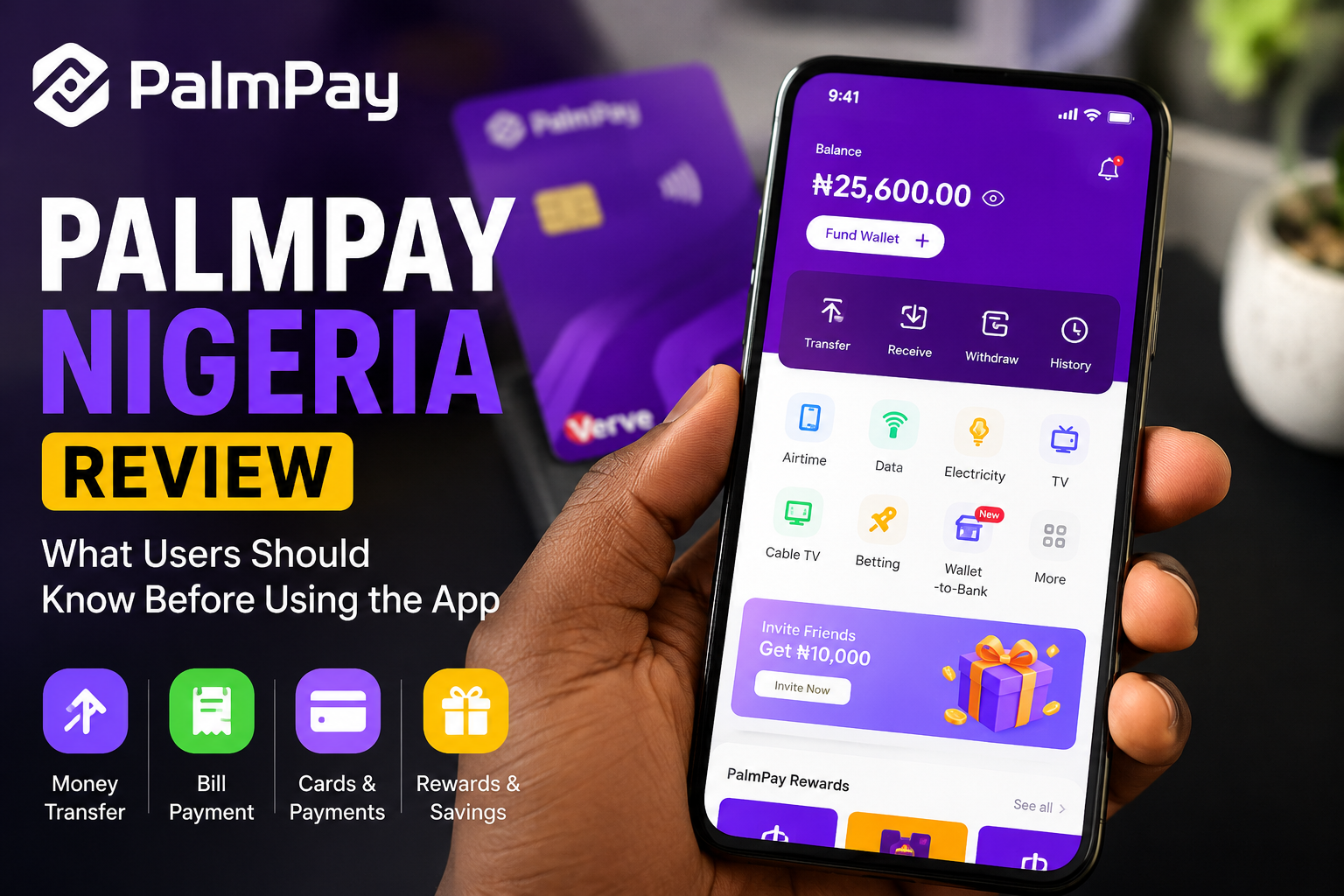
PalmPay Nigeria is one of the payment apps many Nigerians turn to when they want transfers, bills and airtime to work without stress.
You open the app to send money.
You expect the transfer to arrive fast.
You want free or low-cost charges.
And if something fails, you want clear support.
That is why PalmPay is not just another fintech app. For students, traders, small business owners and everyday users, it can become part of daily money movement. But before relying on it, users need to understand how it works, what it offers, what it charges and what risks to watch.
Short answer: PalmPay Nigeria is a mobile money app for transfers, bill payments, airtime, data, cards, rewards, savings and other financial services. It can be useful for everyday payments, but users should check current fees, product terms, support channels and security settings before using it as their main wallet.
What we verified
This article is written and edited by Tech Embed.
It is based on PalmPay’s official website, PalmPay’s Google Play listing, the Central Bank of Nigeria’s payment service provider list and public support information reviewed at the time of writing.
Tech Embed did not independently test live PalmPay transfers, failed payments, savings withdrawals, card use or customer support response times for this review.
Fees, rewards, savings rates, loan terms and product availability can change. Users should confirm the latest details inside the PalmPay app or on official PalmPay channels before making financial decisions.
What is PalmPay Nigeria?
PalmPay Nigeria is a mobile money and payment app used for everyday financial tasks.
The app is built around account opening, money transfers, bill payments, airtime, data, cards, rewards, savings and loans. PalmPay’s Google Play listing describes it as a financial app for account opening, money transfer and bill payments in one place.
PalmPay is also listed by the Central Bank of Nigeria under the Mobile Money Operator licence category as PalmPay Limited. That matters because payment apps handling user money should be visible within the regulated financial system. The CBN’s payment service providers list includes PalmPay Limited under mobile money operators.
Still, a licence does not mean users should stop being careful. Mobile money apps can be useful and regulated, but users still need to protect their accounts, check transaction details and report problems quickly.
PalmPay Nigeria at a glance
| Feature | What users should know |
|---|---|
| Transfers | PalmPay promotes unlimited free transfers to all banks, but users should still check current app terms. |
| Bills | Users can pay for airtime, data and other bills through the app. |
| Card | PalmPay says users can apply for an ATM card through the app or get one from a local card agent. |
| Rewards | The app promotes coupons, cashback, discounts and free-transfer offers. |
| Savings | PalmPay advertises savings products such as Cashbox and SmartEarn, with rates that users should verify before saving. |
| Loans | PalmPay’s app listing says loans are powered by Blooms MFB Ltd. |
| Security | PalmPay says it uses encryption, transaction screening, PCI DSS certification and fraud monitoring. |
| Support | PalmPay lists 24/7 support through helpline, email and other channels. |
How PalmPay works for everyday payments
PalmPay’s main value is convenience.
A user can open the app, send money, buy airtime, pay bills or check wallet activity without visiting a bank branch. For people who move small amounts often, that convenience matters.
A student may use PalmPay to buy data before class.
A trader may use it to receive payment from a customer.
A small business owner may use it to pay electricity or send money to a supplier.
A salary earner may use it for bills, airtime and everyday transfers.
PalmPay’s app listing says users can send money to over 500 financial institutions, buy data bundles, recharge airtime on Nigerian networks, use an ATM card and access wallet-based financial products.
That makes PalmPay a broad consumer payment app, not just a transfer tool.
PalmPay fees and charges
PalmPay promotes free transfers as one of its major selling points.
Its Nigeria page says users can make unlimited free bank transfers with no daily limits and no hidden fees. Its app listing also says users can enjoy unlimited free transfers to all banks.
That is useful for people who send money often.
But users should still check current fees inside the app. Fintech pricing can change. Promotions can change. Some costs may depend on card use, bill payment providers, account type, loan products, savings products or regulatory charges.
PalmPay’s public pages do not work like a full traditional bank tariff guide. The safer approach is to check the charge preview before completing a transaction.
Before sending a large amount, test with a smaller transfer. Before using a savings or loan product, read the terms inside the app. Before using a card, check whether there are issuance, withdrawal, maintenance or replacement charges.
PalmPay rewards, cashback and savings
PalmPay leans heavily on rewards.
The app listing mentions coupons, free transfer chances, cashback and discounts. For frequent users, that can make the app feel more attractive than a plain bank transfer tool.
PalmPay also promotes savings products. Its app listing mentions Cashbox and SmartEarn, including advertised annualised returns. It also mentions loans powered by Blooms MFB Ltd., with repayment periods from 61 days to 6 months and an annual percentage rate of up to 36%.
Users should treat these features carefully.
Rewards are helpful only when they are still active and easy to use. Savings returns should be checked against the product terms. Loans should never be taken because an app makes them easy to access.
The practical rule is simple: transfers and bill payments are daily convenience tools. Savings and loans are financial decisions. Read the terms before using them.
Is PalmPay Nigeria safe?
PalmPay makes several security and trust claims.
Its Google Play listing says it is licensed and regulated as a Mobile Money Operator by the Central Bank of Nigeria and insured by the Nigeria Deposit Insurance Corporation. It also says PalmPay uses encryption to protect personal and transaction information, screens transactions to prevent fraud and money laundering, and is PCI DSS certified.
The CBN payment service provider list confirms PalmPay Limited under the mobile money operator category. The app listing also states that PalmPay is recognised by NITDA and complies with the Nigeria Data Protection Regulation for information security standards.
These are useful trust signals.
But safety also depends on user behaviour.
Do not share your one-time password. Do not give your PIN to anyone. Do not let strangers “help” with your account. Confirm the recipient’s name before sending money. Use a strong phone lock. Report suspicious activity quickly.
If your phone is stolen, act fast. If money leaves your account without permission, report through PalmPay support and keep evidence of the transaction.
Customer support and failed transactions
Support matters because failed transactions are stressful.
PalmPay’s app listing says 24/7 customer support is available. It lists a helpline, support email, website and Lagos address. PalmPay’s help centre also directs users to support information for common issues.
If a transfer fails or money is deducted without value delivered, users should start inside the app. Open the transaction receipt, check whether there is a feedback or dispute option, and contact support with the transaction details.
Keep screenshots. Keep the transaction reference. Note the date, amount, recipient and issue.
If the issue is not resolved by the provider, CBN’s complaint lodgement guide says customers should first report complaints to the financial institution involved. If the institution does not resolve the complaint within the stated timeline, customers may escalate to the CBN’s Consumer Protection Department.
This does not mean every failed transaction should go straight to the regulator. It means users should know the escalation path when normal support fails.
Who should use PalmPay Nigeria?
PalmPay is best for users who want a mobile wallet for daily payments.
It may suit students who buy data often, traders who receive small transfers, salary earners who pay bills from a phone, and users who like free-transfer offers or rewards.
It can also be useful for small businesses that need simple wallet payments, but it is not the same as a full payment gateway.
A business that needs checkout pages, card processing, settlement dashboards, developer tools or cross-border payment support may need more than PalmPay. For businesses comparing online payment infrastructure, Tech Embed’s Paystack vs Flutterwave guide explains how payment gateways differ beyond mobile wallets.
That difference matters.
PalmPay can help with everyday wallet use. A payment gateway helps a business collect payments online in a more structured way.
PalmPay Nigeria pros and cons
Pros
PalmPay is useful for everyday transfers, bills, airtime and data.
It promotes free bank transfers, which can appeal to frequent users.
The app includes rewards, coupons and cashback offers.
It provides card, savings and loan features, based on its public app listing.
It is listed by CBN as a mobile money operator.
Cons
Fees, rewards and product terms can change.
Public pages may not show every charge or limit users will meet inside the app.
Support quality may vary by issue, account status and transaction type.
Savings and loan products require extra care because they involve financial risk.
PalmPay is not a full replacement for a business payment gateway.
Final verdict
PalmPay Nigeria can be a useful payment app for everyday users.
Its biggest appeal is convenience: transfers, bills, airtime, data, rewards, card access and wallet features in one app. For many Nigerians, that is enough reason to try it.
But users should not treat convenience as a substitute for caution.
Check fees before you send money. Read savings and loan terms before using them. Protect your PIN and OTP. Test with small transfers before relying on the app for urgent payments. Keep evidence when something fails.
A good payment app should make money movement easier. A smart user still checks the details before trusting it with daily financial life.
Source and author note
This review was prepared by Tech Embed using PalmPay’s official website, Google Play listing, help centre, the Central Bank of Nigeria’s payment service provider list and public complaint guidance.
Tech Embed did not run live PalmPay transactions for this article. Where fees, rewards, support timelines, product terms or app features may change, readers should confirm the latest details inside the PalmPay app or through official PalmPay channels.
FAQ
What is PalmPay Nigeria?
PalmPay Nigeria is a mobile money app for transfers, bills, airtime, data, cards, rewards, savings and other financial services.
Is PalmPay safe to use in Nigeria?
PalmPay is listed by the Central Bank of Nigeria as a mobile money operator. Its app listing also says it uses encryption, PCI DSS certification and fraud monitoring. Users should still protect their PIN, OTP and phone access.
Does PalmPay offer free transfers?
PalmPay promotes unlimited free transfers to all banks. Users should still check current terms in the app because fees, promos and limits can change.
Can I use PalmPay for bills and airtime?
Yes. PalmPay’s app listing says users can buy airtime, purchase data bundles and pay bills through the app.
Does PalmPay have a debit card?
PalmPay says users can apply for an ATM card through the app or obtain one from a local card agent, and that the card can be used at POS terminals, ATMs and online channels.
What should I do if a PalmPay transfer fails?
Start with the transaction receipt inside the app and contact PalmPay support with the transaction reference, date, amount and recipient details. Keep screenshots and escalate only if normal support does not resolve the issue.
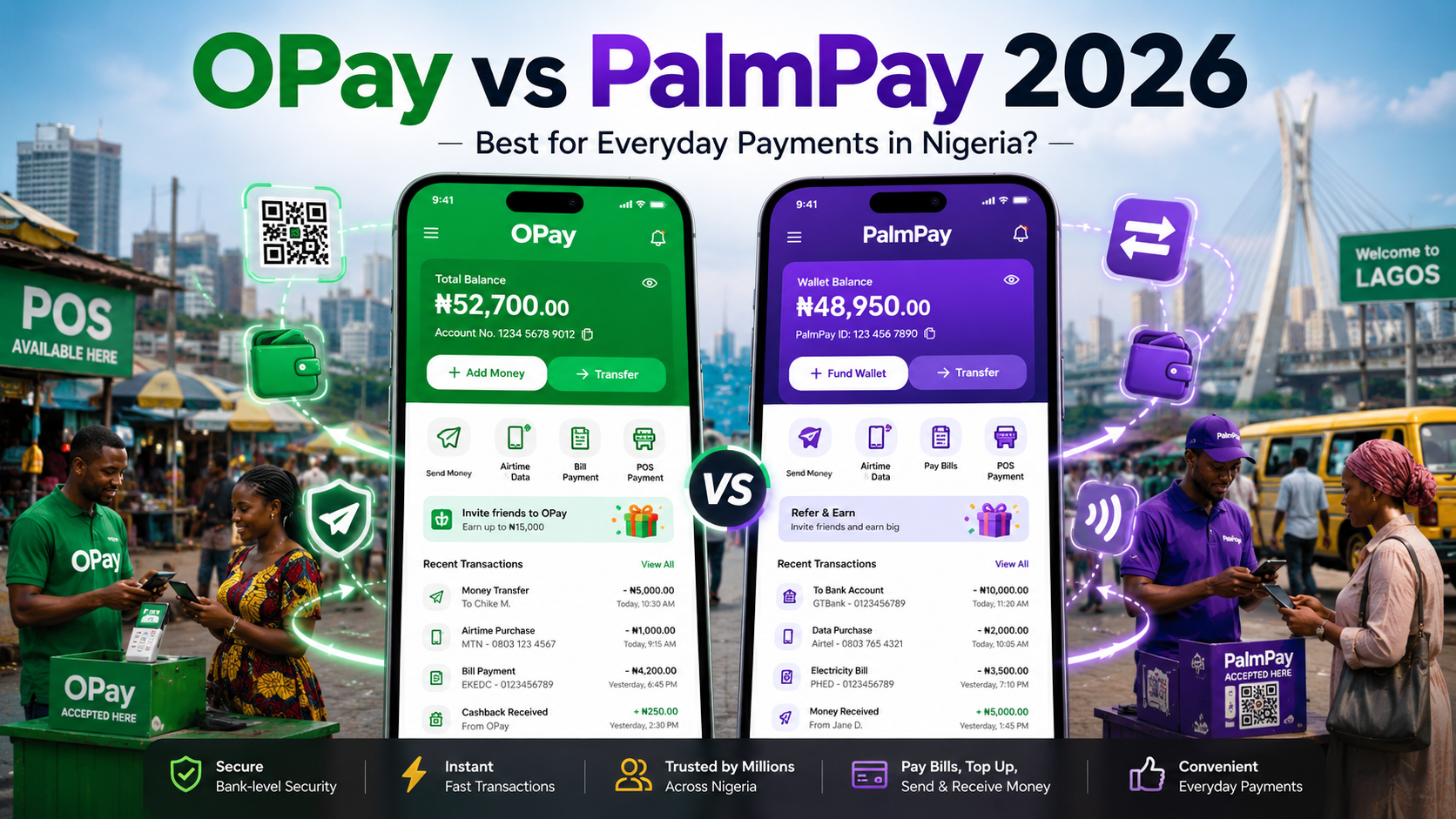
Is PalmPay better than OPay?
PalmPay may appeal to users who care about free transfers, rewards and app-based wallet features. OPay may appeal to users who want broad agent visibility and everyday payment reach. The better choice depends on how you use mobile payments.
About Tech Embed
Tech Embed is a digital media platform covering technology, fintech, startups and digital trends across Nigeria and Africa. We focus on breaking down complex systems into clear, practical insights that explain how technology affects everyday life and business.
We publish analysis-driven content on digital systems shaping the African tech ecosystem.