



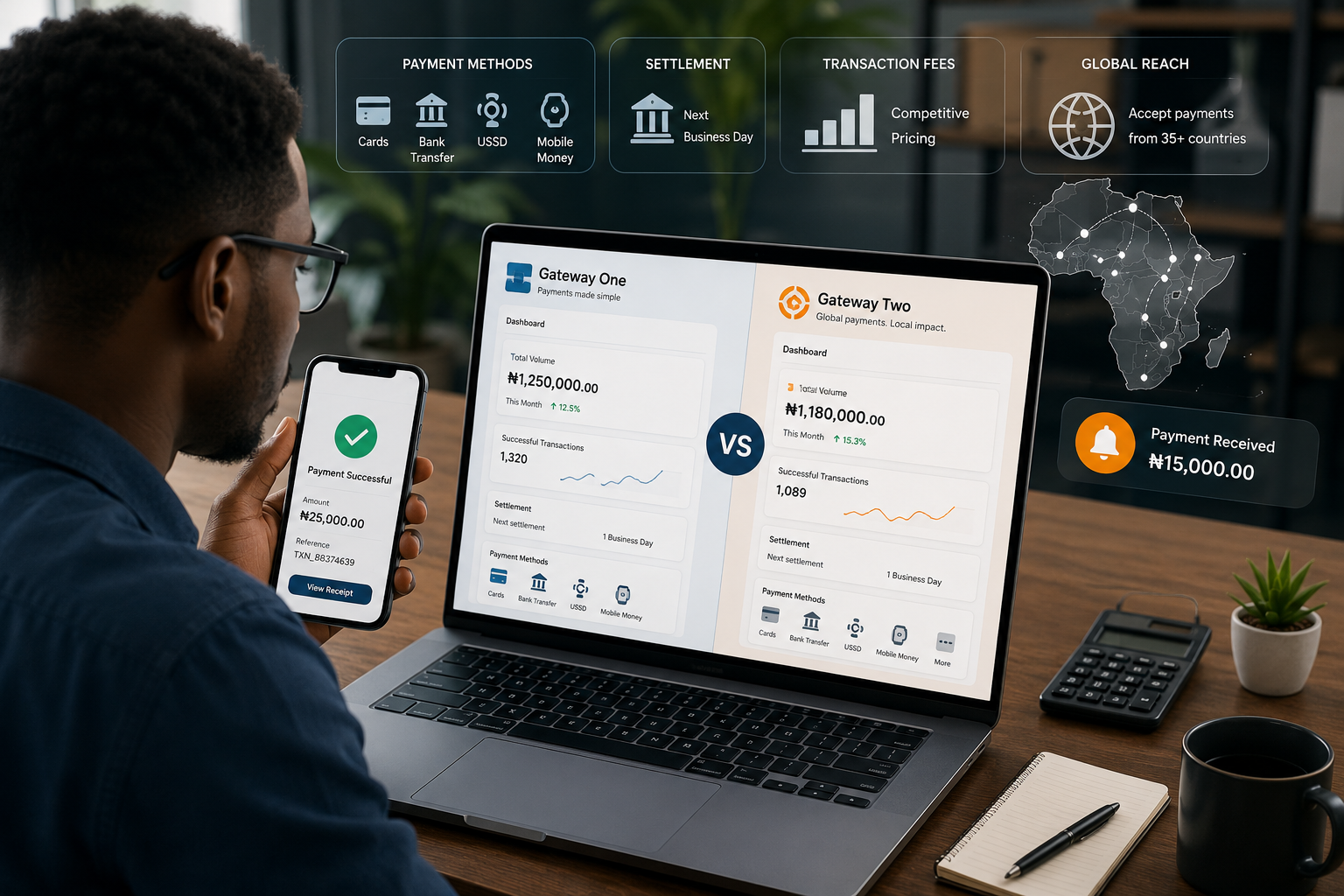
Paystack vs Flutterwave is one of the first payment decisions many Nigerian businesses face when they want to start accepting money online.
You may already have the product, the customer and the sales page. The harder question is what happens when the customer tries to pay.
Will the card work? Will bank transfer show up quickly? How much will the gateway charge? When will the money settle? And if something fails, how easy will it be to fix?
This comparison breaks down Paystack and Flutterwave by fees, payment methods, settlements, developer tools, business fit and the trade-offs Nigerian businesses should check before choosing.
Short answer: Paystack is a strong fit for many Nigeria-first businesses that want a simple payment setup. Flutterwave is stronger for businesses that need broader African or international payment coverage. The better choice depends on your customers, payment channels, settlement needs and technical setup.
What we verified
This article is written and edited by Tech Embed.
It is based on official Paystack and Flutterwave pricing pages, developer documentation and support pages reviewed at the time of writing.
Pricing and payment availability can change. Before integrating either platform, confirm the latest fees, settlement timelines and supported payment methods on the official pages.
Tech Embed did not independently test live transactions for this comparison. The article focuses on published product information and practical business fit.
Paystack vs Flutterwave at a glance
| Factor | Paystack | Flutterwave |
|---|---|---|
| Best fit | Nigeria-first businesses that want a clean setup | Businesses that need wider African or international payment reach |
| Local card fee in Nigeria | 1.5% + ₦100, with ₦100 waived below ₦2,500 and a ₦2,000 cap | 2.0% for Nigeria local cards, made up of 1.4% transaction fee and 0.6% platform fee |
| International card fee | 3.9% + ₦100 | 4.8% |
| Nigeria transfer fees | ₦10, ₦25 or ₦50 depending on transfer size | ₦10, ₦25 or ₦50 depending on transfer size |
| Local settlement | Next working day for Paystack Nigeria merchants | Generally next business day for local payments |
| International settlement | Depends on the currency and setup | Generally five business days for international payments |
| Developer experience | Strong API docs, plugins and checkout tools | Broad payment options, APIs and business tools |
| Better for | Simple local collections, SMEs, startups and developers | Cross-border collections, multi-market businesses and broader payment-channel needs |
What Paystack does well
Paystack is easy to understand for many Nigerian businesses because it is built around a clear core job: help businesses collect payments online and offline.
For a small business, that matters. Not every merchant wants a complex payment stack. Some just need a reliable checkout, card payments, bank transfer, USSD and simple settlement into a Nigerian bank account.
Paystack’s published Nigeria pricing is straightforward. According to Paystack’s pricing page, local transactions cost 1.5% + ₦100, with the ₦100 fee waived for transactions under ₦2,500. Local transaction fees are also capped at ₦2,000. International transactions cost 3.9% + ₦100.
Paystack also supports multiple payment channels. Paystack’s developer documentation says businesses can accept payments through cards, mobile money accounts, QR codes, bank accounts and USSD where those channels are supported.
For developers, Paystack has a strong documentation culture. Its API lets teams collect payments, manage transactions and handle operations available from the dashboard. It also offers plugins for major shopping platforms, which helps businesses that do not want to build everything from scratch.
Paystack’s biggest advantage is focus. If your business mostly sells to Nigerian customers and you want a clean card, transfer and bank-payment experience, Paystack is often the simpler place to start.
What Flutterwave does well
Flutterwave’s strength is breadth.
It is built for businesses that want to collect payments across more markets and more payment types. Its Nigeria payment options include cards, USSD, bank transfer, bank account, internet banking, NQR, eNaira and OPay, according to Flutterwave’s developer documentation.
Flutterwave also positions itself around global and cross-border payments. Its Nigeria collect-payments page says businesses can collect payments globally with APIs and business tools, and accept payments through multiple channels.
That makes Flutterwave attractive for businesses that are not only selling inside Nigeria.
An online school with students in different African countries, a creator selling to international customers, or a business with regional expansion plans may find Flutterwave’s wider coverage useful.
The trade-off is that wider coverage can also mean more things to check: supported countries, settlement currencies, payment method availability, compliance rules, fees and the exact customer experience in each market.
Paystack vs Flutterwave fees in Nigeria

Fees are important, but they should not be the only reason to choose a payment gateway.
For local card payments in Nigeria, Paystack lists 1.5% + ₦100, with the ₦100 fee waived below ₦2,500 and a ₦2,000 cap. Flutterwave’s pricing page lists Nigeria local card fees at 2.0%, made up of a 1.4% transaction fee and a 0.6% platform fee.
For international cards, Paystack lists 3.9% + ₦100. Flutterwave lists 4.8%.
For transfers in Nigeria, both platforms publish a similar fee ladder: ₦10 for transfers of ₦5,000 and below, ₦25 for ₦5,001 to ₦50,000, and ₦50 for transfers above ₦50,000. Flutterwave also notes that transaction fees are subject to VAT.
On paper, Paystack appears cheaper for many local and international card collections in Nigeria. But the real cost depends on your payment mix.
A business that receives mostly bank transfers may care less about card pricing. A cross-border business may care more about supported currencies, settlement options and whether customers can pay smoothly from their country.
Payment methods and customer experience
Payment methods matter because Nigerian customers do not all pay the same way.
Some use debit cards. Some prefer bank transfer. Some want USSD. Some may use account-based payments or wallets depending on the service and bank.
Paystack supports channels such as cards, bank account, bank transfer, USSD, QR, mobile money and POS where available. Flutterwave’s Nigeria options include cards, USSD, bank transfer, account, internet banking, NQR, eNaira and OPay.
For a local SME, the question is simple: which method do your customers actually use?
If most customers pay by card or transfer in Nigeria, both platforms can work. If your customers are spread across multiple African markets or need payment methods that vary by country, Flutterwave may offer more room.
Customer experience also matters. A slightly cheaper gateway is not helpful if customers abandon checkout because they do not trust the flow or the payment method they prefer is missing.
Settlement, cash flow and support
Settlement is where payment gateways become a business operations issue.
Paystack says Nigerian merchants are automatically settled to their bank account the next working day. It also lists free automatic settlement within 24 hours on its Nigeria pricing page.
Flutterwave’s settlement documentation says local payments are generally settled on the next business day, while international payments are generally settled after five business days.
For a business with daily inventory needs, that timing matters.
A food vendor, ticket seller or logistics-heavy business may need fast access to funds. A SaaS business or digital product seller may be able to tolerate longer settlement cycles, especially for international transactions.
Support is harder to judge from public pages alone. Both companies provide help centres and documentation, but real support quality can vary by issue, account status and transaction type.
Before choosing, test the support flow. Ask a pricing question. Try to resolve a small issue. Check how refunds, failed payments and chargebacks are handled.
Developer tools and integration
For developers, both Paystack and Flutterwave are serious payment platforms.
Paystack’s API is RESTful and JSON-based. It uses standard HTTP methods and requires authentication for most requests. Its developer page also highlights APIs for transactions, transfers, settlements, subaccounts and account verification.
Flutterwave also offers developer tools for checkout, payment methods, bank account payments and settlements. Its payment-method documentation is especially useful when a business needs to know which payment options work in which country or currency.
The better developer choice depends on the product.
If the product is a Nigeria-first website, marketplace or SaaS tool, Paystack may feel easier to integrate and maintain. If the product needs more countries, currencies or region-specific payment options, Flutterwave may be worth the extra setup work.
Why local context matters
Payment tools often look simple until local access, settlement and currency rules appear.
A global payment product may be popular, but that does not mean Nigerian users get the same experience as users in the US or Europe. Tech Embed has covered a similar access problem in its guide to using PayPal in Nigeria, where availability and local restrictions shape what users can actually do.
The same thinking applies here.
Do not choose Paystack or Flutterwave only because other businesses use it. Choose based on how your own customers pay, where they are located and how quickly your business needs access to funds.
Which one should your business choose?

Choose Paystack if your business is mostly Nigeria-focused and you want a simple, clean payment setup.
It is a strong fit for online stores, small businesses, creators, local SaaS products, Nigerian schools, service businesses and startups that mainly collect naira payments from Nigerian customers.
Choose Flutterwave if your business needs wider payment coverage.
It is a strong fit for businesses selling across African markets, merchants that want more country-specific payment options, companies collecting from international customers, and teams that need broader payment infrastructure beyond Nigeria.
Use both only if there is a real business reason.
Some companies use more than one payment gateway to improve payment success, support different customer groups or reduce dependence on one provider. But this adds complexity. You will need to handle reconciliation, refunds, support tickets and reporting across two systems.
Final verdict
There is no universal winner in the Paystack vs Flutterwave debate.
For many Nigeria-first SMEs, Paystack is the cleaner first choice because its pricing is easy to understand, its local card fee is lower on published Nigeria pricing, and its product feels focused for local collections.
For businesses with cross-border plans, Flutterwave may be the better fit because it supports wider payment methods and is built around multi-market payment collection.
The smart move is to test with your actual business case.
Check the current fees. Confirm the payment methods your customers use. Run small test transactions. Review settlement timing. Ask support a real question before you go live.
A payment gateway is not only a checkout button. It affects cash flow, customer trust and how quickly your business can recover when payments fail.
Source and author note
This comparison was prepared by Tech Embed using official Paystack and Flutterwave product, pricing, developer and support pages.
Tech Embed did not run live payment tests for this article. Where pricing, settlement timing or payment availability may change, readers should confirm the latest details on the official provider pages before making a business decision.
FAQ
Is Paystack better than Flutterwave?
Paystack may be better for Nigeria-first businesses that want a simple payment setup. Flutterwave may be better for businesses that need broader African or international payment coverage.
Which is cheaper, Paystack or Flutterwave in Nigeria?
Based on published Nigeria pricing, Paystack is cheaper for many local card transactions at 1.5% + ₦100, with a cap and waiver rules. Flutterwave lists Nigeria local card fees at 2.0%. Always confirm current pricing before integrating.
Can Nigerian businesses use both Paystack and Flutterwave?
Yes. Some businesses can use both, especially if they serve different customer groups or markets. But using both adds reporting, reconciliation and support complexity.
Which is better for international payments?
Flutterwave may be stronger for broader cross-border coverage. Paystack also supports international payments, including international cards and some USD settlement options for eligible Nigerian businesses.
Which is better for small businesses in Nigeria?
Paystack is often the simpler first option for small Nigeria-focused businesses. Flutterwave becomes more attractive when the business needs more payment channels, more countries or stronger cross-border coverage.
About Tech Embed
Tech Embed is a digital media platform covering technology, fintech, startups and digital trends across Nigeria and Africa. We focus on breaking down complex systems into clear, practical insights that explain how technology affects everyday life and business.
We publish analysis-driven content on digital systems shaping the African tech ecosystem.
Source notes can be added in the editorial fields for this story.
No comments